1999-2010
Showing posts sorted by relevance for query peter brennan. Sort by date Show all posts

Thursday, September 03, 2009

More photos! Cristina's Court's Emmy night

Cristina Perez moments aftr her winning her second Emmy

So is anyone still talking about the Daytime Emmy Awards? In the case of the Outstanding Legal/Courtroom Program, the answer is resoundingly "Yes." The second win in a row by Cristina's Court not only is giving new attention to judge Cristina Perez and the show's production team--but has a lots of execs pointing fingers for canceling the show midway through its second championship season!

Senior supervising producer Lisa Brennan and executive producer Peter Brennan

Our favorite story is the one about the Fox exec who uttered these immortal words when he got the news: "Oh, sh#$!!"

Cristina with fellow two-time Emmy winner Dean Manibog, who produced and did most of the field camera work for the award-winning episode.

We've got more exclusive photos. Why stop the party now?

Jerry Kupcinet, Cristina & Peter Brennan

2009 Daytime Emmy Award
Outstanding Legal/Courtroom Program
Cristina's Court

Host: Cristina Perez
Executive Producer:
Peter Brennan

Co-Executive Producer:
Jerry Kupcinet
Senior Supervising Producer:
Lisa Lew

Senior Producer:
Dean Manibog

Senior Show Producer:
Terry Powell

Coordinating Producer:
Robin Craig


Producers:
Sandra Gin

Judson Touby

Monique Stinson

Patrick Harris
Trisha Boyd
Danette Kubanda

Richard Velasquez

Dione Calderoni
Megan Hundahl

Michele Fitzgerald
Jeannine Sullivan

Co-host: Reynard Spivey

Bailiff Reynard Spivey holds court-- and Judge Cristina!

Saturday, June 21, 2008

Exclusive! The top dog behind Cristina's stunning, in-your-face Emmy upset over old Judge Judy


The stunning Emmy upset night as the upstart syndicated Fox show Cristina’s Court beat old standby Judge Judy for the first-ever Daytime Emmy award for Outstanding Legal/Courtroom Program is made all the more tasty because Cristina’s executive producer Peter Brennan basically created Judge Judy as a show and a character as Judy's first EP, guiding her in the new arena while his staff, headed up by Cristina Emmy winner Lisa Brennan, found the cases that put the show a class above the rest— until they moved on.

Weeks before the debut of Cristina’s Court in September 2006, we told you that “Judge Judy’s genius has a new star,” and pointed out that

“…Brennan tells stories like no other, and his team knows the key to a successful court find cases that may not be earth-shattering but are crucially important to the people who are pressing them. They also know to find litigants who don’t look like they were scraped off the floor of Jerry Springer’s waiting room.”

Well, that team, including senior producer Dean Manibog— Katy, Texas’ first Emmy winner (we want to be there for the parade), are polishing Emmys this morning, and must be chuckling that Judge Judy sat stewing at the next table at the Kodak Theatre last night.

As we told you last night, the episode that clinched Cristina’s Court’s prize concerned the shooting of a pit bull.

An animal story. Odd, no?

Not at all. This excerpt from Tabloid Baby, describing the early years (1987-90) of tabloid television, shows how Peter Brennan used the same tried-and-true formula to great success nearly twenty years ago:

Animal stories and tabloid TV go back to the genre’s roots in Australian and British tabloid newspapers... Animal stories attracted calls and letters. They made up for the other sins you put on the screen.

Our most memorable animal story at A Current Affair was about an old dog named Smoke in a town somewhere down south. One day, Smoke ran down the railroad tracks, smack into the path of an oncoming train. When Smoke’s distraught owner went out to see if there was anything left of his old hound, he found an ear, a leg another leg, the tail, a scrap of fur—that was about it.

That would have been the end of the story, except that a week or so later, Smoke picked himself up from wherever he was carried several miles up the track and came hobbling home, minus that the ear, tail, fur and those two legs. It was inspirational, all right. Brennan wanted to run it just so he could write in the promo:

“It was the day the train kept a rollin'… ON TOP OF OLD SMOKIE.”

Friday, June 20, 2008

Celebration for A Pit Bull: Cristina's Court's dog story beats Judge Judy for first court show Emmy


Cristina's Court, the syndicated daytime courtroom series starring blonde Telemundo crossover Cristina Perez, beat Judge Judy, Judge Hatchett, the People's Court and gay judge David Young tonight for the Television Academy of Arts and Sciences' first Emmy for Outstanding Legal/Courtroom Program.

In a nice twist, Cristina's executive producer is Peter Brennan, the godfather of tabloid television and the original producer of Judge Judy (who was widely credited for guiding the court show queen to her initial success).

The episode that was judged and which won the Daytime Emmy award was Requiem for A Pit Bull, the story of the life and death of the two-year-old family dog that demonstrated Brennan's unique gifts for finding and telling stories that strike a personal and universal nerve. The power of the story ws such that influential animal rights groups like PETA and Last Chance for Animals joined the Hollywood crusade to see the segment, the producers behind it, the courtroom TV star who fronted it and the show that featured it, get the award they deserved.

It was "a hair-trigger episode that divided much the nation and pitted two of the country's most intense lobby groups head to head on the case --the gun lobby versus animal rights.

"It stemmed from an incident that took place on an average street in Austin, Texas one day last summer....and a dog named Capone...

"The 911 call told a story":

911: "What's your emergency?" Caller: "A pit bull for about the fifth time just chased me and my dog inside my house...he's very vicious. He growls his teeth and he charges you."

911: "Is anybody hurt?"

Caller: "No but I just killed the dog."

He was a young pit bull named Capone. Was he a playful, friendly pup, motherless and hand fed from the day he was born, as his owner described? Or a vicious, aggressive potential killer on the loose, as described by the man who shot him.


The decision was up to Judge Cristina Perez in TV's Cristina's Court.


Allen Saadeh, 20, and his mother were suing neighbor Louis Cross for killing their family pet with a .22 rifle. Cross, 40, who told Judge Cristina one of his hobbies was hunting, admitted he pumped five .22 caliber bullets into Capone the day he caught him in the yard of his Austin, TX. home.


"It was aggressive, showing it's teeth." Cross said.


"Are you scared," asked the judge.


"I am scared."


Cross said he had previously warned Saadeh about the dog being loose. "I said listen, this is the last time I am coming to you about your pit bull in my yard. I am going to shoot it."


Saadeh said he never took the threats seriously. "He was a very good dog. He was like a little boy to me."


The judge asked Cross to describe the shooting.


Cross said he found Capone in his side yard and the dog growled at him and his weiner dog. He then went back inside the house and took a .22 rifle from his gun cabinet.


"I shot him twice in the head and he stood there and looked at me," said Cross.

"What did you do next?"


"I shot him three times right there (pointing to his ribcage), and he died."


"You shot him five times?"


Saadeh said he searched for his dog for three days before Cross admitted to him that he had shot Capone and thrown the body in a dumpster.


"You murdered that dog," said Judge Cristina.

The winners:

Outstanding Legal/Courtroom Program

CRISTINA'S COURT
SYNDICATED

PETER BRENNAN, EXECUTIVE PRODUCER
LISA BRENNAN, SUPERVISING PRODUCER
ROBIN CRAIG, COORDINATING PRODUCER
DEAN MANIBOG, SENIOR PRODUCER
WANDA HENLEY, PRODUCER
LESLIE BROWN, PRODUCER
LISA WILSON, PRODUCER
MICHELLE FITZGERALD, PRODUCER
GYLLIAN CARTER, PRODUCER
JUDSON TOUBY, PRODUCER
SANDRA GIN, PRODUCER
CRISTINA PEREZ, HOST

Monday, June 23, 2008

Exclusive! Team that beat Judge Judy at the Emmys


Senior producer Lisa Brennan and executive producer Peter Brennan flank star Cristina Perez and Emmy, after picking up the award for Outstanding Legal/Courtroom program at the 35th annual Daytime Emmy Awards at the Kodak Theatre in Hollywood Friday night. The win was a surprise, since some believed the new category had been created so Judge Judy could win an award after years of going up against talk shows. The catch is that peter Brennan was Judge Judy's original executive producer, and credited with Judy's initial success before doing the same for a new generation with Cristina.

Friday, May 15, 2009

Cristina's Revenge! Second nomination for canceled Emmy-winning courtroom show


Cristina's Court and its star Cristina Perez won the first-ever Daytime Emmy Award for Outstanding Legal/Courtroom Program last year, even though the category was created so Judge Judy would get a statuette and the hot blonde Cristina's program was only in its second season. Fox stations group boss Roger Ailes rewarded Cristina and crew by canceling the show with the intention of replacing her with a scandalized Republican party political hack who was doing half the ratings with a court show on the CW but also did his bidding on his Fox News and sought the nomination to run for Senate against Hillary Clinton.

Tonight, Cristina's got her revenge, with a second Emmy nomination.

The nominated episode:


“CRISTINA’S COURT” NOMINATED FOR 2009 DAYTIME EMMY
FOR "OUTSTANDING LEGAL/COURTROOM PROGRAM"

2008 Daytime Emmy Winner Looks for Back-to-Back Wins

LOS ANGELES, May 15, 2009 – “Cristina’s Court,” hosted by Cristina Perez, was nominated for its second Daytime Emmy. In its debut year, Cristina’s Court became the second highest-rated new show in U.S. syndication. In only its second year, Cristina’s Court won the first-ever Emmy award for Outstanding Legal/Courtroom Show. Cristina’s Court is poised to once again prove that quality is golden.
Regarding the announcement, Cristina commented, “We are very excited! What a privilege to be named along with the other nominees. I’ve had an opportunity to work with amazing people that brought their personal best everyday to Cristina’s Court. We appreciate the academy’s recognition of that quality hard work. Personally, I am blessed that I’ve been able to make a strong connection with viewers.”

“Cristina’s Court” is executive produced by court veteran Peter Brennan, who launched “Judge Judy” and “Judge Joe Brown.” Peter Brennan stated, “This is wonderful. Cristina is amazing. She brings a special life to each show and has the uncanny ability to bring out the best in all people before her. Her on-air presence, engaging personality, legal expertise and ability to relate to people brought a new dimension to the court genre.”

Cristina is considered an ultimate crossover host, who while being a hip, professional, multicultural woman, always seeks to introduce traditional values into the lives of people young and old. Consequently, she appeals to young and old audiences everywhere. With a passion for law, family and culture, Cristina was the first television judge ever to crossover from Spanish-language to English-language television and previously hosted Telemundo’s highly-rated “La Corte de Familia,” which was one of the highest rated Spanish-language programs in the U.S. She made her television debut with “La Corte Del Pueblo” (“The People’s Court”), on Los Angeles’ KHWY-TV. A 2008 Syndicated Network Television Association survey ranked Cristina second (behind Oprah Winfrey) among adults age 18-34 as the “most trustworthy” host on TV. In the “most influential” category, she is ranked fourth in two separate demographic groups. Cristina is ranked in the top 20 or better in all of the demographics surveyed, proving her ability to transcend gender and age in attracting viewers. Cristina is in development for several fresh, new programming concepts and is writing her second book (Penguin Books) which is expected to be released in early 2010.

FOR MORE INFORMATION PLEASE VISIT:
www.cristinaperez.tv

Sunday, August 30, 2009

No fluke: Canceled Cristina's Court wins second Daytime Emmy for Outstanding Courtroom Program


Cristina's Court has won the Emmy award for Outstanding Legal/Courtroom Program for the second year in a row.

The show starring Cristina Perez and produced by (tabloid) television legend Peter Brennan picked up the statuette last night at a ceremony at the Bonaventure Hotel in Los Angeles.

Cristina's Court stunned the television world when it picked up the first-ever Emmy Award for Outstanding Legal/Courtroom Program a year ago. That win was the biggest news to come from last year's Emmy Awards, because it was the first court show Emmy, and generally assumed to have been created in order to give Judge Judy a prize.

Last night's announcement proved that Cristina's Court's first Courtroom Program Emmy was no fluke. The win was suspected a few weeks ago when the Emmy producers decided-- after the votes were counted-- to remove the popular category from tonight's televised awards show and stick it with the the technical awards that were handed out hours ago.

The second Emmy does come with bittersweet cheer. The Fox Television Stations Group canceled Cristina's Court in February to make room for a court show featuring Republican politician Jeanine Pirro, which had been running to lower ratings on Fox's CW Daytime lineup. Republican adviser and Fox News president Roger Ailes is also chairman of the Fox Stations Group.

Cristina's executive producer Peter Brennan, who created the tabloid television genre with A Current Affair, was the original producer of Judge Judy.
Developing...

Thursday, February 21, 2008

Cristina courts a Daytime Emmy, doggedly


The Daytime Emmys have come out with a new "Outstanding Legal/ Courtroom" category, finally recognizing the special nature of "courtroom shows," the staple of daytime television pioneered (and re-invented) by Tabloid Baby pal and mentor Peter Brennan of A Current Affair, Hard Copy and Judge Judy fame. And chief among the potential nominees has got to be this entry from Latina crossover superstar Cristina Perez:


Cristina's Court is produced by Peter Brennan himself. Man does know his tabloid.

Watch the episode here.

And, thanks to a new twist in Daytime Emmy rules ("...for the first time, all of those entered into the Daytime competition will have their achievements viewed by judges..."), you might even be able to vote for it. Find out more here.

Monday, October 09, 2006

Fox News at 10: Time magazine rewrites history

Time magazine has helped shape the conventional wisdom in American media for decades, and it’s following tradition today by doing its usual mainstream best to rewrite history in its semi-tribute to Fox News’ ten years of power.

Time credits— or blames— Fox News for changing the face of television news. But that’s a little like crediting the Sex Pistols for inventing punk rock. Before Johnny Rotten came to town, there were the Stooges. There were the Dolls.

And in this case, there was tabloid television, as envisioned, invented and carried out by Peter Brennan and his band of Aussie pirates and Yank hangers-on, first at A Current Affair and then at Paramount’s Hard Copy in the late Eighties and early Nineties. They shook up television news and set it on the course that landed Katie Couric in Dan Rather’s seat, long before Roger Ailes got on board at Fox and took the existing tabloid television template, replaced the good-natured Aussie democratic takedown humour with a nasty streak, added noxious right-wing politics and GOP ass-smooching to the mix and began filling hours of airtime with yakking heads.

Sure, Fox News influenced, confused and led its cable news competitors by calling it “fair and balanced” with a nudge and a wink. They helped keep America in fear after 9/11, gleefully greased the skids to the Iraq war, scared the competition from speaking out against Bush’s regime, kept Bill O’Reilly on the air despite a perverted sex (the repressed Catholic only talked about it) and office sexual harassment scandal, pioneered the don’t-ask-don’t tell gay newsreader policy far better than CNN, and through memos and meetings, kept ominous party line “talking points” in the background of every newsday.

But though “it’s still possible,” as Time says, “to divide the news calendar into BF and AF—Before Fox and After Fox (‘Fox’ meaning Fox News),” it’s a bit offbase when it insists that “much of what you see on TV news exists because of Fox.” Without the tabloid television team that set the stage and provided many of the bodies for Fox News to get off the ground (veteran tabloid innovators Ian Rae and Jerry Burke were among the Fox News start-up crew), Roger Ailes wouldn’t have had a game plan.

Years ago, when Marvin Kitman was writing an authorized biography of Bill O'Reilly (whatever happened to that?), we explained to him that Fox News was succeeding because it looked into the camera lens and envisioned its audience as the same target tabloid television had conjured—white, lower-middle class, with the kids and parents gathered together, with a grandparent in a rocking chair, at suppertime. Kitman was fascinated to realize that the doofus was succeeding because unlike the news vets who ran the straightlaced Inside Edition, his Fox bosses were allowing him to unleash his inner Maury Povich.

We led Marvin to the book, Tabloid Baby. And we lead Time to the book's Epilog, written in Disneyland in 1999:

“…Tabloid television and network news are unrecognizeable compared to what they were when it all began. Former network newsreader Deborah Norville may be hosting Inside Edition, but it was her successor at NBC’s Today show, Katie Couric, who was on the scene in Littleton, Colorado, a couple of mornings after the massacre at Columbine High in April 1999… Yes, the twain have met, they’ve mated, and Murrow’s legacy of idealism has exchanged fluids with Murdoch’s rules of cynicism…”

Specifically:

TIME FACTOID: “In the end, that wink—that is, the Fox gestalt of insouciance, attitude, and even playfulness—has had a bigger effect on the news media than any Bill O'Reilly rant.”

FACT: The wink, the “gestalt” (look it up), the playfulness: Ailes took it from Peter Brennan’s tabloid TV template.

TIME FACTOID:“Fox taught TV news that voice, provocation and fun are not things to be afraid of. “

FACT: Tabloid TV.

TIME FACTOID: “Probably every TV news program outside of PBS has been Foxified by now.”

FACT: Watch PBS news. They do it well.

TIME FACTOID: “The explosive graphics on your newscast: that's Fox.”

FACT: See the “Ka-chung”

TIME FACTOID: “The ‘freeSpeech’ opinion segments on the new CBS Evening News: that's Fox, too. Anderson Cooper yelling at a FEMA official or crusading in Africa: that's Fox. Keith Olbermann ranting at George W. Bush and O'Reilly on MSNBC's Countdown: that's Fox through and through…”

FACT: That’s Tabloid Television.

TIME FACTOID: “Ailes’ argument that nearly every other mainstream media outlet slants left is self-serving and mostly wrong. (The MSM really slant toward the institutional, establishmentarian center, which is a bias as dangerous as any other.)”

FACT: Ailes is right. The “MSM” slants to the left.

Anyway, in days to come, there will be a lot of “think” pieces and features blaming or praising Fox News for its ten-year reign of GOP terror. But tabloid television has been a neglected influence. Its heroes, from Dunleavy to Abramovitz to Holloway, have been largely forgotten by that “MSM.” And remember, when A Current Affair and the team reassembled last year, it was Roger Ailes who wrested power over its broadcast division and quickly pulled the plug on the show—before anyone could recognize that the TV wizard was not a fat man behind the curtain, but actually from Oz.

Read all about it here.

Friday, August 25, 2006

Legally Blonde: Judge Judy's genius has a new star


Here's the next big daytime TV hit, and the next multimillionaire daytime TV judge, brought to you by the man who invented tabloid television, revolutionized morning news shows, created Judge Judy, and then brought Judge Joe Brown to TV riches.

Peter Brennan’s latest brainchild is Cristina’s Court, starring Spanish television star Cristina Perez, familiar to our Latin friends from her show, ‘Corte de Familia’ on Telemundo and soon to be the first Latin legal star to make the crossover to the American mainstream.

September 11th is the debut date for Cristina’s Court (see the sales tape above). The geniuses who do the scheduling probably forgot it’s the fifth anniversary a big event (and the day that 9/11 hero , becomes Father Michael Judge is eligible for sainthood), so there are bound to be pre-emptions, but it will be worth catching up with.

Brennan tells stories like no other, and his team knows the key to a successful court find cases that may not be earth-shattering but are crucially important to the people who are pressing them. They also know to find litigants who don’t look like they were scraped off the floor of Jerry Springer’s waiting room.

Young, blonde and from Colombia (though most viewers assume she's Mexican), Cristina is bound to be the next big TV judge.

Australian-born Brennan’s role in the rise and fall of tabloid television is well-documented in Tabloid Baby. He was at the helm of last year’s ill-fated relaunch of A Current Affair, which was cancelled abruptly when Fox News boss Roger Ailes took over the Fox stations and stuffed his pet Geraldo in the timeslots (Ailes actually copped the Fox News template from the tabloid television formula, taking the basic principles and injecting ugly right-wing warmongering politics into the mix).

Coincidentally, another player from the early days of tabloid television is succeeding behind the scenes with a female TV star. Big Gordon Elliott, famed for his TV “doorknocks” on Brennan's Good Day New York and A Current Affair (and other exploits recounted in Tabloid Baby), in recent years could be found on the Food Network and Campbell’s Soup ads. He discovered a Southern cooking lady named Paula Deen, whose “Paula’s Party” launches September 29, and is said to be the network’s new hope.

The reinvented Gordo has avoided us since Tabloid Baby was published at the end of 1999 (he features in some great stories, but nothing to be ashamed of!), so if you see him, send him Tabloid Baby’s best wishes!

Monday, December 06, 1999

New York Observer: Steve Dunleavy and the Rise of Tabloid TV


Steve Dunleavy Snowplow Shocker!
In the opening pages of Tabloid Baby , television producer Burt Kearns’ memoir about the rise and fall of tabloid television, he writes that New York Post reporter Steve Dunleavy, “the ageless legend with his silver pompadour, eagle beak profile and rakish charisma, was the paragon of everything that made journalism romantic and dangerous. He was friend to cops and criminals, bums and kings. He knew the words to any show tune you could toss at him.” And then Mr. Kearns gets to the point: “Dunleavy, it was said, would fuck anyone, do anything– fuck anything –for a story.”
In journalistic parlance, that is the nut graph to Mr. Kearns’ first-person account of his immersion in the sweaty, up-all-night 120-proof world of tabloid television that media mogul Rupert Murdoch brought to America when he imported a band of Australian “wild pirates,” as Mr. Kearns referred to them in a phone interview, to run the American TV and media properties that he had purchased. In addition to Mr. Dunleavy, there was Peter Brennan, whom Mr. Kearns credits as the father of tabloid TV, and a young writer-producer named Wayne Darwen who was rarely without his milk carton full of vodka. (“Oy’m a wombat, baby,” Mr. Darwen would say, according to Mr. Kearns. “Eats roots and leaves.”) Rounding out the (hard-) core pirates were Mr. Kearns, a New Yorker who came by way of producing news for WNBC-TV and WNEW-TV (which became WNYW when Mr. Murdoch bought it), and a ponytailed Lithuanian Jew from Baltimore named Rafael Abramovitz.
Tabloid Baby , which was published without an index by a Nashville house called Celebrity Books ($27.95), chronicles the genesis of A Current Affair , Hard Copy and the tabloid TV genre, which caught fire in the mid-to-late 1980′s with the Robert Chambers preppy murder case and the Rob Lowe sex tape scandal (which is covered in a chapter called “Rob Lowe’s Big Dick”) and essentially came to an end with the O.J. Simpson trial, when the Big Three Networks and The New York Times decided they could hold out no more.
Mr. Kearns’ and his fellow pirates’ attitudes toward the networks is best exemplified in a chapter labeled “Jeff Greenfield Is a Big Fat Humorless Putz,” which details what happens when cameramen for the show Mr. Kearns is producing, Premier Story , were sent to tail then-ABC analyst Jeff Greenfield as he attempts to get in on the O.J. action. Mr. Greenfield, who is now a senior analyst at CNN, said his recollection of the incident was that it “was not journalism. This was thuggery.” As for the chapter title, Mr. Greenfield said that because the word putz “is a term of art,” he did not take issue with it, but he did not agree with the “Big Fat” or “Humorless” descriptions. In regard to his weight, Mr. Greenfield said: “I welcome him to check me out.” He then added: “Humorless? I don’t know. I do Imus every couple of weeks. He generally doesn’t have humorless folks on the show.”
Mr. Kearns employs a more affectionate version of this warts-and-all tabloid cheekiness when recounting the exploits of his own comrades, and Tabloid Baby is peppered with stories that have been making the rounds of the city’s tabloid newsrooms for years. For instance, he writes that during his first encounter with Mr. Dunleavy, “Dunleavy extended a bony hand, smiled, began to speak–and his false front tooth fell out of his mouth and plopped into my drink.”
Indeed, if the book justifies anything, it’s that Mr. Dunleavy deserves his title as the Keith Richards of tabloid journalism.
About halfway through the book, Mr. Kearns recounts how, around the time of Joey Buttafuoco’s rise to fame, Mr. Dunleavy in the midst of telling a joke at Elaine’s, begins to choke on his steak. Before Mr. Kearns could administer the Heimlich, and with Valerie Perrine and Sam Shepard watching in horror, Mr. Dunleavy coughed up the killer morsel of meat. Then, “He wiped off his chin, put the handkerchief and meat in his pocket, and to Sam Shepard’s obvious horror, resumed his drinking.”
Later that evening, when he and Mr. Kearns exit Elaine’s, Mr. Kearns catches Mr. Dunleavy looking down Second Avenue, “perhaps remembering his most embarrassing and life-threatening moment after leaving this restaurant on a snowy night not too many years ago.” Perhaps struck by the majesty of the city blanketed in white, Mr. Dunleavy “and a female companion stopped to make love on a snowdrift when they were run over by a city snowplow. Dunleavy suffered a broken leg.” (Mr. Dunleavy did not return a call asking him to comment about his exploits chronicled in Tabloid Baby , but in a column about the book that he wrote for the Post , Mr. Dunleavy noted: “Of course, I normally would have sued the son-of-a-gun for what he wrote about me, but I can’t–it’s all doggone true.” )
Mr. Kearns is less clear about the veracity of what he calls “the most famous Dunleavy and Brennan legend of all”; and with good reason. The story involves the two men allegedly taking a hit out on Ian Rae, the loyal Murdoch soldier with the nickname, “The Pig,” who had been brought in to oversee the development of A Current Affair .
Mr. Kearns writes that in the early years of A Current Affair , Mr. Brennan and Mr. Dunleavy “decided in a late night drinking bout that Ian Rae had brought them such misery that he deserved to die. The two of them were pissed as a couple of wine cellar rats, full as a state school, but Dunleavy managed to find the bar phone and dial up an old buddy, a union man known to take care of such requests.”
In Mr. Kearns’ recounting of the legend, Mr. Dunleavy “went back to the vodka” and didn’t realize what he’d done until a few hours later. When, according to Mr. Kearns’ story, he tried to rouse Mr. Brennan, Mr. Brennan mumbled: “Fuck the Pig. The Pig must die.”
When Mr. Dunleavy then tried to call back the union man, he found that he had already left for work. “I called in a hit on Ian Rae!” Mr. Dunleavy is alleged to have said. “It’s not free, you know. What was I thinking? What were we drinking–”.
Mr. Dunleavy’s remarks were then supposedly interrupted by the arrival of Mr. Rae in the office, which prompted Mr. Dunleavy to plant a big one on Mr. Rae.
Mr. Kearns writes about the legend in relation to his own thoughts about hiring someone to kneecap an old beau of his girlfriend, but when he brings up the Rae story to Mr. Dunleavy, saying: “You tried to take out the Pig!” Mr. Dunleavy replies: “That’s bullshit, it’s just a fucking story.”
Mr. Kearns’ book shows that even when the tabloid TV men weren’t on a story they couldn’t help acting like pirates. There’s a gruesome scene in 1991 that involves Mr. Kearns getting in a good-natured dust-up with former Good Day New York personality Gordon Elliott while Mr. Elliott is driving a carload of tequila-fueled swashbucklers on a mission to find Heidi Fleiss’ home. Mr. Kearns ends up being thrown from the moving car and then later gets hit in the face by one of his own cowboy boots (thrown by Mr. Elliott, of course). In a moment of tenderness, Mr. Elliott “held open my blood-spouting mouth and stuck his meaty fingers inside, feeling around gently to see if he’d knocked loose any teeth.” In reality, a hole had been ripped in Mr. Kearns’ cheek and a torn blood vessel had become a gusher. The front of Mr. Elliott’s rental car “looked like a fucking abattoir,” wrote Mr. Kearns, who landed in the hospital. Later, he added: “Gordon wouldn’t drink again for a couple of years.”
Then there’s the time that the tabloid guys are having dinner at Odeon and they spy David Letterman dining with an entourage at another table. Knowing that Mr. Letterman is unhappy with them for airing an interview with Margaret Ray, the woman who kept breaking into his Connecticut house (and would later commit suicide), they send over a cheap bottle of wine with a note that employs one of Mr. Letterman’s catch phrases at the time: Bite me.
According to Mr. Kearns, the note said: “To Dave: Bite Us. Drink This.” But Mr. Letterman “read the card, dropped it and resumed his conversation. He didn’t even crack a smile.”
Eventually, a lot of people began to feel the same way about the no-holds-barred mentality of the tabloid television guys, even as the networks began invading some of their turf. “We got a lot of people in power angry at us,” said Mr. Kearns, who eventually realized, “If you’re going to run with the pirates, in the end you walk the plank.”
Mr. Kearns, who married Alison Holloway, the correspondent of one of his tabloid shows, Premier Story , is now the father of a son. After leaving the tabloid TV business, he made a living as a professional gambler, but he has since returned to producing. He said he has produced an hourlong documentary for the Animal Planet cable network and was co-producer on an HBO piece called Panic! about anxiety attacks. But Mr. Kearns said his most recent producing job was Fox’s When Good Pets Go Bad II .
Mr. Kearns will be traveling to New York on Dec. 1 for a panel about tabloid and celebrity journalism that will take place at 6 P.M. at Borders book store on Park Avenue. Mr. Kearns said Mr. Dunleavy will moderate the discussion.

Wednesday, October 13, 1999

Seek Books Update: Tabloid Baby

by ED BRESLIN

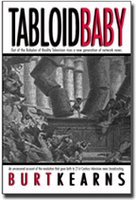
Two weeks back this column focused on the enthusiasm the people at HarperCollins have for the upcoming memoirs of TV honcho Roone Arledge. But his book won’t be out for about a year. Already, for those interested in the history of journalism, and especially TV journalism, there is a book just out worth serious attention. The book is Tabloid Baby by Burt Kearns.

Burt Kearns was a young and talented reporter for local Connecticut newspapers before he moved to NYC and latched onto a job in television with NBC News. From there he moved to the new Fox Network. Next thing he knew he was producing shows for A Current Affair, the smash tabloid news TV show Fox introduced in the early 80s. For years A Current Affair set a hot pace, outdistancing its many imitators. It also shook up programming trends and practices within the American TV industry. Much of this was due to the influence of imported British and Australian journalists, TV reporters, producers and directors.

Shows like A Current Affair and its less successful spin-off Hard Copy changed the face of American TV journalism. They also changed the way all news was reported. They changed the way stories were selected for feature treatment. They changed the tone and treatment accorded stories. They even dramatized the manner of reporting a story. They were up-close, they were personal. They were humanly engaging in a way news stories had never before been. Traditionalists loathed their new, let-it-all-hang-out style. But today the reverberations of that style are to be seen everywhere, even on once stodgy network news programs, as the subtitle of Tabloid Baby boldly asserts: "Out of the Babylon of Reality Television Rises a New Generation of Network News."

A Current Affair and shows like it went gonzo. They pioneered guerrilla reporting by such swashbucklers as Steve Dunleavy, now a featured columnist on the New York Post. Dunleavy was a sort of gangsta investigator, a reporter more akin to Spiderman than to Walter Cronkite. The younger reporters and producers like Burt Kearns learned from Dunleavy. Kearns also learned a lot about TV delivery from Australian producer Peter Brennan, who never met a story he couldn’t spice up, jazz up, personalize, and dramatize. Brennan could have spun the obit of Mother Teresa and slashcut her funeral for pace.

Dunleavy and Brennan were only two of the manic characters whirling with energy and talent Burt Kearns worked with. There was also wizard reporter and interviewer Rafael Abramovitz, the distinguished TV show host Maury Povich, the giant and intimidating reporter Gordon Elliott, the sparkplug reporter David Miller, and the manic and nearly berserk producer Wayne Darwen, who contrasted with the calm and measured producers Ian Rae and Dick McWilliams. All of these guys would have attacked the Great Wall of China with a safely pin if a great story had been on the other side. Reading about them in Tabloid Baby you feel that Burt Kearns has done for them as marauding journalists what Robert Louis Stevenson did for pirates in Treasure Island.

Tabloid Baby is published by Celebrity Books, appropriately enough, and priced at $27.95 for 490 bristling pages. Every big news story of the 80s and early 90s is showcased in here. What’s more, Burt Kearns proves the old journalism adage that the story behind the story is often the best story. Tabloid Baby provides as much high-octane entertainment as any Hollywood expose, and, into the bargain, it concerns a very serious subject, and sheds a sharp light on it: the nature of journalism at the dawn of the millennium.

Sunday, January 29, 2006

Black Bart Brennan, a good old dog

Tabloid television creator, innovator and godfather Peter Brennan sent out the following email this evening:

"The original 'Tabloid Dog,' Black Bart Brennan, has passed on, aged 18 years (human). Bart, adopted from the West LA pound in 1990, was the Black Lab-Chihuahua mix whose immense IQ was purposely never measured against the tabloid producers who for years would come to visit him, first at his Coldwater Canyon home and in later years at Slash's old house on Sunset Plaza Drive. Bart refused to chase balls, mix with other dogs and most humans. He is missed by his best friends Fletch and Ali."

Bart was a good old dog. He witnessed or participated in many an adventure. He was very lucky to have Fletcher and Ali as his pals, especially in the final months. We said our goodbyes to old Black Bart on New Year’s Eve. Long may he run.

Wednesday, December 08, 1999

Salon.com: Tabloid Nation


The man who produced "Hard Copy" and "A Current Affair" remembers the gory, golden age of trash TV.


Tabloid television isn’t dead. Shows such as “A Current Affair” and “Hard Copy” that thrived on news, gossip and scandal and brought the world dramatic reenactments and hidden-camera scoops were simply made redundant.

Burt Kearns was a producer on both of those shows. To hear him tell it, tabloid TV simply morphed into network news magazines, syndicated talk shows, ceaseless cable “news” coverage and those morning programs where the men all wear sweaters and the coffee is decaffeinated.

“When I want to watch my tabloid stories now,” says Kearns, “I’ll watch the ‘Today’ show. There’s no better tabloid team than Matt Lauer and Katie Couric.”

This may come as news to anyone who thinks tabloid TV was, in its purest form, all about Elvis sightings and ax murders. But for Kearns, who is in New York promoting his book “Tabloid Baby,” an amusing if somewhat self-serving account of his years in the business, most people just don’t get it. And that includes many of the programmers who imitated and co-opted the brass-tacks style of his early shows. “Nobody is covering those stories the way we covered them,” he complains. “They’re doing it the network way. They’ll do a story on a UFO cult and cut to Keith Morrison at NBC and he’s rolling his eyes. They still look down on people.”

Kearns doesn’t look that different from any number of Los Angeles TV producers. An affable, good-looking man in his early 40s, he’s talking to me between appearing on a panel on tabloid TV and doing a radio interview. Appropriately, he has chosen Langan’s — an Irish bar in midtown Manhattan frequented by New York Post writers — for our interview; so much of “Tabloid Baby” (which covers the period from Kearns’ 1989 arrival at Fox’s “A Current Affair” to the cancellation of Paramount’s “Hard Copy” earlier this year) floats by on a sea of vodka. And Steven Dunleavy, a Mephistophelean character in Kearns’ book, writes a column for the Post now. In fact, during the interview he appears at the bar as if conjured and signals the barman for a refill while lighting a Parliament.

“Joey Adams died today,” says Dunleavy solemnly in his Aussie accent. He’s wearing a corduroy jacket that nearly matches the color of his tan, and he sports a Porter Wagoner-style pompadour.

“No shit?” says Kearns. Adams, husband of Post gossip columnist Cindy Adams and aggregator (if not author) of a million one-liners, had been ill for some time. “Cindy was supposed to be on this panel with me last night but said she had family business.”

There is a beat before he adds: “At least it was a real excuse.”

With its hard drinking and quick cynicism, the world that “Tabloid Baby” limns is a sort of throwback to yellow journalism’s days of yore. “In the worldview of ‘A Current Affair,’” Kearns writes, “people didn t insult the Church, and sex was naughty — the word unsaid, only spelled out, S-E-X — values needed to be upheld, and all offensive images needed to be shown in as explicit detail as the lawyers would allow.”

This combination of titillation and hypocrisy was imported from Australia by Rupert Murdoch, who staked his claim to the States when he purchased 20th Century Fox and the Metromedia TV stations in the mid-’80s and formed the Fox Broadcasting Corp. And when he needed news magazines, he didn’t look to “60 Minutes” as a role model. He called on some of the same Aussie journalists who had reinvented the print tabloids for him there — men like Dunleavy and Peter Brennan.

It is Brennan whom Kearns credits with splitting the atom of the tabloid-TV formula. “Now, you get back from a story, what happens?” Brennan would ask his charges. “You talk to people. You go to a bar and your friends say, ‘What were they really like? What really happened?’ If you give an answer that wasn’t in the story, if the viewer or your mother can ask what the people in your story are really like, you’ve told the typical television version of the story. ‘A Current Affair’ tries to do the story between the lines and turn it into lines.”

For Kearns, who came to Fox from WNBC, this new way of reporting was liberating. “In the so-called legitimate news,” Kearns tells me, “the idea was to make sure you have the same story everyone else does and make sure you cover it the same way, and make sure you have what everyone else has. With ‘A Current Affair,’ you’d walk in each morning and say, ‘What’s the most interesting story going on right now?’”

And according to Kearns, they didn’t take their lead from the supermarket tabloids, either. The “Current Affair” staff scanned hundreds of newspapers for offbeat stories. They broke a map of the United States into five sections, like the five boroughs of New York, and assigned reporters to cover each. And, OK, they pissed off a number of celebrities in the process.

“It was never journalism,” Kearns says of what they were doing. “It was what the Australians would call a piss-take on journalism.” And it was much safer — and more just — to “take the piss” out of public figures like Steven Spielberg, whose divorce from Amy Irving got the “Current Affair” treatment, including clips from “Jaws” that equated interloper Kate Capshaw with Bruce the Shark. This resulted in a phone call from Spielberg to Fox studio head Barry Diller, which Kearns interprets as follows:

“Hello, Steven!”

“Barry, if I live to be 90, I will never do a movie for Fox.”

Kearns estimates that cost the company around $500 million.

In an effort to infuse the show with some semblance of respectability, Murdoch sent Anthea Disney to police the troops. Disney had worked her way up through the ranks of Murdoch’s empire, starting as a Fleet Street reporter. She cultivated a tough-cookie persona (I worked for her myself at another venture) and she put the “Current Affair” staff on notice. She told Variety that she was under orders to make the show “more New York magazine and less New York Post.” Kearns, who had advanced to executive producer, saw the writing on the wall and resigned to go to Hollywood and join the rival tabloid show, “Hard Copy.”

Disney is one of many who may not be pleased at how they are depicted in “Tabloid Baby.” Her stated desire to class up “A Current Affair” clashed with some of the excesses that occurred on her watch — most notably Steve Dunleavy’s payment to a witness in the William Kennedy Smith trial. (The $40,000 he paid to Anne Mercer, who drove Smith’s alleged victim from the Kennedy mansion that night, caused Mercer’s testimony to be discredited. “I have to thank Steve Dunleavy for what he did with Anne Mercer,” Smith’s attorney said when his client went free.)

Kearns is not above floating a few old rumors about Disney’s marital problems and personal life in his book, and says that she tried to keep it from getting published. “She was running HarperCollins at the time,” he says. “She’d seen the book. It went to her company. She didn’t want it published. I don’t hold that against her.”

“Bullshit,” says Disney, who is now vice president of content at News Corp.  “I never saw his book and wasn’t aware that it came to HarperCollins. It makes a much better story to say that someone tried to stop your book than to say that no one wanted to publish it.”

The Kennedy Smith saga was a “Hard Copy” exclusive at first; “A Current Affair” and “Inside Edition” tried to take the high road. “And the network guys didn’t understand that it was news,” says Kearns.

“Shows how wrong they were. And it showed how little sleazy tabloid stories can turn into news. It ignited the whole debate on date rape, naming the victims in rape trials.” (It’s worth noting that the New York Times was one of the first papers to identify Smith’s accuser by name.) “And then, months later, when Clarence Thomas was up for the Supreme Court judgeship, and he got involved in the thing with Anita Hill, Teddy Kennedy, the great voice of liberalism, couldn’t open his mouth because he’d been shamed in this case.”

One could argue that almost any Kennedy story can be made into tabloid fodder without turning the dial too far, what with that big back story of family tragedy and misadventure. The first real crossover tabloid story of the ’90s broke on May 10, 1992, when Amy Fisher shot Mary Jo Buttafuoco in Massapequa, N.Y. It had all the elements of a true-life soap — the clueless wife, the loutish Lothario, the mystery vixen — save one.

“There was no one in the story you could feel sorry for,” says Kearns, “no one that you could identify with. In every tabloid story there is one character — you see [the story] through that person’s eyes, you identify with that person. In the Buttafuoco story you couldn’t identify with the victim.” As the story morphed and grew, with new revelations every week and more and more perfidy captured on tape, the nation reached saturation. Even People magazine now seemed to subsist on the “Long Island Lolita.” We had become a tabloid nation.

O.J. Simpson, of course, gave us victims we could identify with and a slow train wreck of a trial that was virtually inescapable. The “tabloid babies” of Kearns’ narrative had crossed over to the networks (even as some network people went in the other direction). The first time “Nightline” covered the murders, five days after Nicole Simpson and Ron Goldman were killed, Ted Koppel apologized; when the ratings went through the roof, he quit saying he was sorry.

Soon it was all O.J., all the time, from Regis and Kathie Lee in the morning to Jay Leno jokes at night. The trial itself took center stage and tabloid TV as practiced by Kearns and company seemed downright quaint. “When the world was watching from their offices live,” he says, “we were repackaging it with alliteration and music — who needs that shit?”

Today, in place of “Hard Copy” and “A Current Affair,” we have “Dateline,” “60 Minutes II,” “20/20″ and “48 Hours” — and that’s just on the networks. Kearns wrote some pilots and cast about for a new project.

His collected notes came together in “Tabloid Baby,” which he is promoting now with the help of his wife, Allison Holloway, another veteran of the scene. He doesn’t come out and say that he couldn’t get arrested after a career in tabloid television, though he admits his prospects looked dim. His last project was for Fox: “When Pets Go Bad II.” I ask him how people come up with ideas like that.

“You walk into a room, it’s like the monkeys with the typewriters,” he says. “It’s full of video monitors and people are transcribing every piece of video in the world. And they might find they have 10 great pieces of video of animals attacking people — ‘When Pets Go Bad!’” Voila.

A lot of it is in the packaging — like that film of a donkey sexually assaulting a man whom the beast had found defecating in his pasture. “Fox has always wanted to air it but never could,” Kearns claims. “Every time someone presented it to them they would put on ragtime music and sound effects — ‘Boing!’ I saw it and was horrified. This makes ‘Oz’ look like ‘Touched by an Angel.’ It was horrific. So I played it very straight and put some scary music behind it — ‘This man is invading the territory of an animal …’”

For the holidays they had footage of a Santa being attacked by one of his reindeer. It was a reenactment, actually. The injured Santa was demonstrating how he’d been attacked, but things went badly. “He was screaming, ‘Help!’” Kearns recalls, nursing the last of his beer. “We thought he was doing it for the camera but, no, he was bloody. It rated very well.”

Sean Elder is a frequent contributor to Salon.